


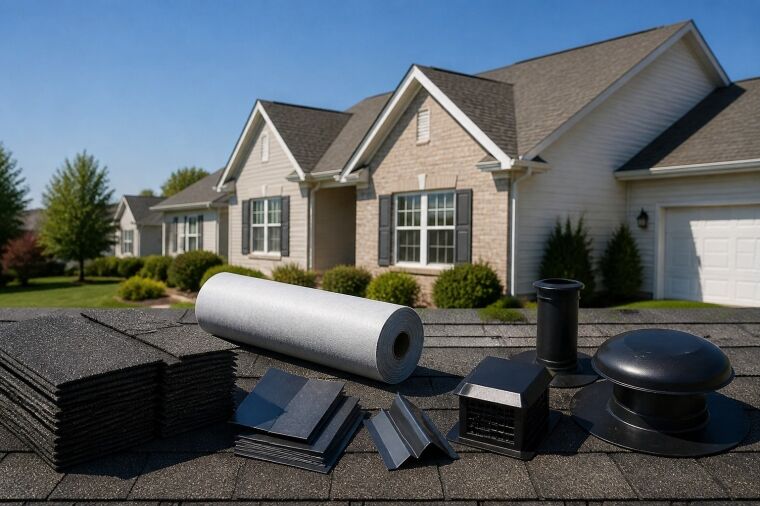
Roofing supply is the business of providing the shingles, underlayment, flashing, ventilation, fasteners and commercial membranes needed to build or repair a roof, and in the Joliet area you can buy these materials from local supply houses or have a roofing contractor source them as part of the job. Which route makes sense depends on the size of the project, your experience, and whether you want warranty coverage tied to a single installer. This guide explains what a roofing supply order includes, where to buy, what to expect on cost, and how to avoid the mistakes that lead to callbacks.
What Does Roofing Supply Include?
Roofing supply covers every component that makes up a complete roof system, not only the visible surface material. A typical residential order includes far more than shingles.
- Roof covering: asphalt shingles, metal panels, or commercial membranes such as modified bitumen
- Underlayment: synthetic or felt layers, plus ice and water shield at eaves and valleys
- Flashing: drip edge, step flashing, valley metal and pipe boots
- Ventilation: ridge vents, intake vents and exhaust vents
- Fasteners and sealants: roofing nails, cap nails, roofing cement and compounds
- Accessories: starter strips, ridge caps, soffit and fascia components
Skipping or under-ordering the small components is a common cause of leaks. Flashing and sealant failures often cause water intrusion long before the shingles wear out. If you want more detail on sealants and patching materials, Great Roofing explains roofing compounds in a dedicated resource.

What Are the Different Types of House Roofs?
The most common house roof types are gable, hip, flat or low-slope, gambrel, mansard and shed roofs, and each one changes the materials and quantities you need to order. Pitch and complexity drive the supply list as much as square footage does.
- Gable roofs have two sloping planes meeting at a ridge. They are the most common style in the Joliet area and are straightforward to shingle.
- Hip roofs slope on all four sides. They need more ridge cap and cutting waste.
- Flat and low-slope roofs are common on commercial buildings and some additions. They typically use membrane systems rather than shingles.
- Gambrel, mansard and shed roofs each have unique slopes and flashing demands that add detail work.
Valleys, dormers, skylights and chimneys add flashing and waste to the order. Homes with many valleys need more underlayment and valley metal, and you can read about how valley roof construction affects both materials and labor.
Where Can You Buy Roofing Supply in Joliet?
You can buy roofing supply from contractor-focused supply houses, big-box home centers, or through your roofing contractor, and each channel suits a different kind of buyer. The right choice depends on volume, product range and how much support you need.
| Source | Typical strength | Typical limitation |
|---|---|---|
| Contractor supply house | Wide product range, bulk quantities, delivery to the job site | Often geared to trade accounts |
| Home center | Convenient for small repairs and sealants | Narrower selection of shingle lines and commercial products |
| Roofing contractor | Materials, labor and warranty handled together | Product selection tied to the contractor's installed systems |
For a small patch, a home center may be enough. For a full tear-off, pricing, delivery timing and product availability matter more. Great Roofing keeps a resource on roofer supply near me for readers weighing these options. For current availability, order handling and delivery details, contact the business directly rather than assuming a standard policy.
How Much Does Roofing Supply Cost for a 2,000 Sq Ft Roof?
Pricing for a 2,000 square foot roof varies widely, so the most reliable answer is a written estimate based on your actual roof rather than a single national figure. Several variables move the total up or down, and published per-square averages rarely reflect Illinois labor rates or your specific roof geometry.
Material costs are driven by:
- Product tier: standard three-tab, architectural or premium designer shingles
- Roof pitch and complexity: steeper and more broken-up roofs need more material and waste allowance
- Underlayment and ice barrier choices: upgraded layers cost more but improve protection
- Ventilation components: a balanced intake and exhaust system may require new vents
- Tear-off and disposal: removing old layers adds labor and dumpster costs
- Decking repairs: rotted or damaged sheathing found during tear-off changes the budget
Note that the footprint of a house is not the same as its roof area. A 2,000 square foot home can have a noticeably larger roof surface once pitch and overhangs are counted. Roofers measure in "squares," where one square covers 100 square feet of roof. A written estimate that lists materials line by line lets you compare bids fairly.
What Is the 25% Rule for Roofing?
The 25% rule is a guideline in some building codes and insurance policies that limits how much of a roof can be repaired before the entire roof must be replaced, with the threshold commonly set at 25% of the roof area within a set period. The exact wording and whether it applies at all depend on the local jurisdiction and the code edition it has adopted.
Because enforcement varies, confirm the requirement with your local building department before planning a partial repair or re-roof. Insurance policies can include their own thresholds, which is another reason to read your coverage carefully. If storm damage affects a large portion of the roof, the repair-versus-replace decision often turns on both code and carrier rules. Great Roofing's public adjusters handle hail, wind and storm damage insurance claims, and its guides on insurance and hail damage to a roof outline how those claims typically proceed.
Which Roofing Materials Fit Residential and Commercial Projects?
Asphalt shingles dominate residential roofing in the Joliet area, while commercial buildings with flat or low-slope roofs generally use membrane systems such as modified bitumen. Matching the material to the building type is the first supply decision.
Residential shingles
Asphalt shingles balance cost, appearance and durability. When comparing lines, look at wind rating, impact resistance, algae resistance and the length and terms of the manufacturer warranty. Great Roofing is IKO Roof PRO certified and offers material warranty coverage, and its pages on good asphalt shingles and the highest quality asphalt shingles cover what separates one grade from another. Metal is another option for homeowners who want a different profile and lifespan.
Commercial systems
Business owners, multifamily owners and property managers usually work with modified bitumen on low-slope buildings. These systems are installed in layers, and seam quality and flashing detail determine how long they last. Cool-roof surfaces can also lower energy costs: the U.S. EPA reports that in air-conditioned residential buildings a cool roof can reduce peak cooling demand by 11 to 27 percent. Reflective options are worth discussing with your contractor during material selection.
Why Does Ventilation Belong on Your Roofing Supply List?
Attic ventilation belongs on every roofing supply list because it controls heat and moisture that shorten shingle life, and in Illinois it also helps limit winter ice damming. A roof with good shingles but poor airflow can age faster than one with a modest product and a balanced system.
A balanced setup pairs intake vents at the soffit with exhaust vents at or near the ridge. When the intake is blocked by insulation or the exhaust is undersized, warm air and moisture linger in the attic. That can lead to condensation, mold, and shingles that cook from underneath during summer. Soffit condition matters too, since damaged soffit can undermine intake airflow, a topic covered under soffit repairs.
What Safety Rules Apply When Handling Roofing Materials?
Fall protection is the central safety requirement for roofing work, and OSHA generally requires it for residential construction workers exposed to falls of 6 feet or more above a lower level, as described in OSHA’s residential fall protection FAQ. This matters to supply planning because staging materials on a roof adds weight, trip hazards and edge exposure.
A few additional points from the federal rules:
- OSHA defines a low-slope roof as 4:12 or less, and at unprotected edges 6 feet or more above a lower level, specified fall-protection measures are required under OSHA standard 1926.501.
- On low-slope roofs 50 feet or less in width, that standard permits a safety-monitoring system alone as a fall-protection option for roofing work.
- Employers can review OSHA guidance on residential fall protection, including the circumstances in which a written fall-protection plan may be used.
For homeowners, this is a practical reason to hire a trained crew rather than carry bundles up a ladder. For contractors, it is a reason to plan material delivery by roof-top placement or lift so loads are distributed safely.
Should You Buy Materials Yourself or Hire a Contractor?
Buying materials yourself can save on markup for very small repairs, but for a full replacement a contractor-supplied system is usually simpler and better protected. The tradeoff is control versus accountability.
Buying yourself works best when:
- The job is a minor patch or a single-section repair
- You are comfortable with the work and safety demands, as described in DIY roofing considerations
- You can match existing shingles and verify quantities accurately
Hiring a contractor works best when:
- You are replacing the full roof or tearing off multiple layers
- You want one party responsible for materials, installation and warranty
- Storm damage requires insurance coordination
Mismatched quantities and incompatible components are common problems on homeowner-sourced orders, and manufacturer warranties can depend on how and by whom the system was installed. Always confirm warranty terms before purchase.
How Do You Plan a Roofing Supply Order Step by Step?
A reliable supply plan starts with an accurate measurement and ends with a delivery schedule that fits the weather window. Following the steps in order prevents shortages and delays.
- Inspect the roof and decking. Identify damage, layers of existing shingles, and any rotted sheathing.
- Measure the roof area. Account for pitch, valleys, hips and overhangs, then convert to squares.
- Add a waste allowance. Complex roofs need more overage than simple gables.
- List every component. Include underlayment, flashing, vents, fasteners, sealants and ridge caps.
- Choose product lines and confirm warranty terms. Verify what the manufacturer requires for coverage.
- Schedule delivery and tear-off. Time materials to arrive just before installation and plan for Illinois weather; seasonal considerations are covered in winter roofing.
- Plan cleanup. Disposal, magnetic nail sweeps and landscape protection should be part of the scope.
How Does Great Roofing Handle Materials for a Joliet Replacement?
For homeowners who prefer to skip sourcing altogether, Great Roofing manages the materials as part of its residential roof replacement service, which covers tear-off, shingle installation and clean-up. The company is family-owned, veteran-founded and BBB Accredited with an A+ rating, and its crews clean up and leave your exterior landscape better than when they arrived. Great Roofing's team stays in contact at every step, from sales to office to production, and takes ownership of its work, making it right if you are not satisfied. For commercial properties, the company works with modified bitumen systems, and you can review its full range on the services page.
FAQ
Which brands of roof shingles should I avoid?
No single brand is wrong for every roof, so focus on product line specifics instead of brand reputation alone. Compare wind and impact ratings, warranty terms, and whether the manufacturer's coverage requires certified installation. A contractor with manufacturer certifications can explain which lines suit your home and climate.
How do I know how much roofing material to order?
Measure the roof in squares, then add a waste allowance based on complexity. Simple gable roofs need less overage than roofs with many valleys, hips and dormers. A contractor's written estimate should list quantities line by line so you can verify them.
Can I mix materials from different roofing supply sources?
You can, but compatibility and warranty are the concerns. Some manufacturers require their own underlayment, vents or starter strips for full warranty coverage. Confirm the requirements before combining products from different suppliers.
Before you order anything, get your roof measured and inspected so the supply list reflects what the roof actually needs. If you would rather hand off the sourcing, installation and clean-up, Great Roofing is a family-owned Joliet contractor that can handle the whole project, including residential roof replacement. To get a clear materials list and price for your property, Great Roofing will schedule a complimentary estimate once you reach out.