


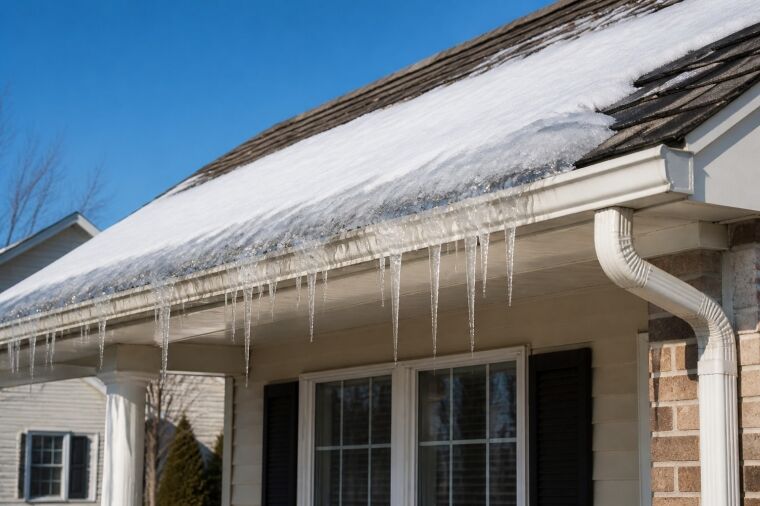
Ice dam roofing problems start when heat escapes from your living space into the attic, melts the snow on the upper roof, and lets the meltwater refreeze at the cold eave, trapping more water behind it. That trapped water can back up under shingles and leak into ceilings, walls and insulation. The cure is a cold, well-sealed, well-insulated attic, and the safest quick fix is to remove snow and ice without damaging the roof or yourself.
For homeowners and property managers in Joliet and the south Chicagoland area, this matters every winter. Freeze and thaw cycles, wind-blown snow and aging attics make ice dams a regular hazard. This guide explains how they form, how to spot them, how to remove them safely, and which permanent fixes work.
What Is an Ice Dam and Why Does It Form?
An ice dam is a ridge of ice that builds along the lower edge of a roof and blocks melting snow from draining off. Three conditions are needed: snow on the roof, heat reaching the underside of the roof deck, and a cold eave.
Here is the sequence:
- Warm air leaks from the house into the attic, or the attic is poorly insulated.
- The upper roof warms above freezing and melts the snow layer beneath the surface.
- Meltwater runs down the slope until it reaches the overhang, which sits over unheated space and stays below freezing.
- The water refreezes into a growing ridge of ice.
- New meltwater pools behind the ridge, rises under the shingles, and finds its way into the structure.
Shingles are designed to shed water that flows downhill. They are not designed to hold standing water. Once a pool forms behind an ice dam, water can travel up and under the shingle courses by capillary action and through nail holes and seams.

How Can You Tell You Have an Ice Dam?
You can recognize an ice dam by thick ice along the eaves, icicles hanging from the gutter line, and water stains or drips inside the home near exterior walls. Not every icicle signals trouble, but heavy, uneven icicle formation often points to uneven roof temperatures and a heat leak above.
Look for these signs:
- A continuous band of ice along the lower few feet of the roof
- Large icicles clustered over certain sections, often above leaky or poorly insulated areas
- Ice built up inside or on top of gutters, with gutters pulling away from the fascia
- Peeling paint, bubbling drywall or brown stains on ceilings along exterior walls
- Damp insulation or frost on the underside of the roof deck when you check the attic
- Water running down the inside of an exterior wall during a thaw
Interior symptoms can appear days after the ice formed, so check ceilings and attic corners after any warm spell that follows heavy snow. If you see damage inside, document it with dated photos. Water damage from sudden roof leaks can sometimes qualify for an insurance claim, and Great Roofing's guide to a roof damage insurance claim explains the general process.
How Do You Remove an Ice Dam Off a Roof Safely?
The safest way to remove an ice dam is to stop the melt-and-refreeze cycle from the inside and clear snow from the roof edge using tools that keep you on the ground. Chopping ice is the most common mistake, and it causes more damage than the dam itself.
Methods That Work
Use a roof rake. A long-handled roof rake with wheels or a slide lets you pull snow off the lowest four to six feet of the roof from the ground. Removing the snow removes the water source, which slows the dam. Rake gently and leave a thin layer of snow so you do not scrape off granules.
Apply calcium chloride in a tube. Fill a long nylon stocking or pantyhose leg with calcium chloride ice melt and lay it vertically across the dam so it melts a channel down to the gutter. This gives the water a path to drain. Avoid rock salt, which can corrode metal flashing and gutters and harm plants below. Keep in mind that this method still requires placing the tube on the roof, so only do it from a ladder at a safe, low height or hire a professional.
Lower the attic temperature. In an emergency, set the thermostat lower, close attic hatches, and move off any heat sources. Placing a box fan in the attic pointed at the underside of the roof deck can pull in cold air and refreeze the meltwater, which reduces pooling.
What Not to Do
- Do not chip, hammer or pry at ice with a shovel, axe or ice pick. Shingles are brittle in cold weather and break easily.
- Do not use a pressure washer, torch or heat gun. Hot water refreezes and a flame is a fire hazard.
- Do not climb onto an icy, snow-covered roof. Falls are the main injury risk with ice dam cleanup.
- Do not poke holes through the roof to drain trapped water.
Steam removal by a professional is the standard method when a dam is large or when water is already entering the home. Low-pressure steam melts the ice without hammering and without heavy water volumes. If water is coming inside, a licensed roofer can also place temporary protection. Great Roofing provides emergency roofing services for situations where a leak cannot wait.
What Causes the Heat Leaks Behind Ice Dams?
Most ice dams trace back to heat loss, not to the roof itself. Typical sources of warm air entering the attic include:
- Unsealed gaps around recessed lights, attic hatches and pull-down stairs
- Open top plates and wall cavities where interior walls meet the attic floor
- Gaps around plumbing stacks, chimneys and electrical penetrations
- Bath fans and kitchen exhaust ducts that terminate in the attic instead of outdoors
- Uninsulated or compressed insulation, especially over soffit areas and finished knee walls
- Leaky or uninsulated ductwork running through the attic
The Pacific Northwest National Laboratory's Building America Solution Center, a U.S. Department of Energy resource, recommends air-sealing and insulating the ceiling plane in vented attics for cold-climate construction. The order matters: seal first, insulate second. Insulation slows heat flow but does not stop moving air, so an unsealed attic floor keeps leaking even under a deep layer of fiberglass.
How Do You Prevent Ice Dams for Good?
Permanent prevention combines three layers: air sealing, adequate insulation and balanced ventilation. Each one supports the others, and skipping any one reduces the benefit of the rest. Ice dam roofing prevention comes down to keeping the roof deck as cold as the outdoor air.
1. Air Seal the Attic Floor
Seal every gap that lets conditioned air rise into the attic. Use caulk for small cracks, expanding foam for larger gaps around pipes and wires, and rigid blocking with sealant for chases and open top plates. Weatherstrip and insulate the attic hatch. Vent bath fans and range hoods directly to the exterior.
2. Add Insulation
After sealing, bring attic insulation up to a level appropriate for northern Illinois. Many local homes built decades ago have far less than current recommendations. Even coverage matters, so check that insulation is not blocked or compressed near the eaves, where baffles are needed.
3. Keep the Roof Deck Ventilated
A vented attic moves cold outdoor air from the soffits, under the deck, and out through the ridge. PNNL's guidance calls for a vent space in each roof bay, running from the soffit vents to the ridge vents. Install baffles at each rafter bay to hold insulation back from the soffit and keep that channel open. Check that soffit vents are not painted over or stuffed with insulation, and that ridge or roof vents are present and unobstructed.
For very cold, high-snow regions, PNNL recommends a ventilating air gap above the roof deck and insulation. That approach shows how seriously building science treats the cold-roof principle.
Quick Prevention Checklist
| Task | Where | Purpose |
|---|---|---|
| Seal gaps and penetrations | Attic floor | Stop warm air from entering |
| Add or even out insulation | Attic floor | Slow heat transfer |
| Install baffles | Rafter bays at the eaves | Keep soffit airflow open |
| Clear soffit and ridge vents | Roof edge and peak | Move cold air under the deck |
| Duct exhaust fans outdoors | Bath and kitchen | Stop moist, warm air in the attic |
| Clean gutters before winter | Eaves | Allow meltwater to drain |
Should You Cover the Whole Roof With Ice and Water Shield?
Covering the entire roof with ice and water shield is usually unnecessary; the membrane belongs along the eaves, in valleys, and around penetrations where leaks are most likely. Ice and water shield is a self-adhering, rubberized underlayment that seals around nails and resists water that backs up under shingles.
Typical placement includes:
- The eaves, extending from the edge to a point at least two feet inside the exterior wall line, which is a common code approach in cold climates
- Valleys, where water concentrates
- Around chimneys, skylights, vents and wall intersections
- Low-slope sections where water drains slowly
Full-roof coverage can make sense on very low slopes, complex roofs with many valleys, or homes with a history of repeated leaks. It costs more and, on a poorly ventilated roof, can trap moisture. The key point is that the membrane is a backup defense, not a cure. It will not stop ice from forming, so it should always be paired with air sealing, insulation and ventilation.
What Is the Best Underlayment for Ice and Water Roofing?
The best underlayment for ice-prone areas is a self-adhering, polymer-modified bitumen membrane installed on a clean, dry deck at the eaves and in valleys, with a quality synthetic or felt underlayment covering the rest of the roof. Self-adhering membranes seal around fasteners, which is the feature that matters when water is pushed up under shingles.
When comparing products, look at:
- Cold-weather adhesion, since winter installs need membranes rated for low temperatures
- Surface traction, so installers can walk the roof safely
- Compatibility with the shingle manufacturer's warranty requirements
- Vapor permeability in areas where the deck needs to dry
Installation quality matters as much as the product. Overlaps, lap direction and proper adhesion to the deck all determine whether the membrane performs. This is one reason to hire a certified installer. Great Roofing is IKO Roof PRO certified and offers 50 years of material warranty coverage, so homeowners who are replacing a roof can ask about underlayment and warranty details during an estimate.
Do Metal Roofs Stop Ice Dams?
Metal roofs do not stop ice dams, but they handle them better than asphalt shingles because snow slides off smooth panels more easily and the seams shed water. Heat loss from the attic still melts snow, and meltwater can still refreeze at the eave. Snow guards are often added to keep sliding snow from falling onto walkways, which matters for entrances.
A metal roof is not a substitute for air sealing and insulation. On residential shingle roofs, which are Great Roofing's specialty, the same principles apply: keep the deck cold, protect the eaves with a waterproof membrane, and keep gutters clear.
What About Gutters and Commercial Roofs?
Clogged or damaged gutters worsen ice dams because water has nowhere to go, and ice in a gutter can pull it off the fascia. Clean gutters in late fall, confirm downspouts discharge away from the foundation, and check that gutter hangers are secure. Great Roofing's gutters services cover repair and replacement for homes with recurring drainage trouble.
Flat and low-slope commercial roofs follow a different pattern. Ice can form at drains, scuppers and parapet walls, where water pools and freezes. Property managers should keep drains clear of debris before winter and watch for ponding water at seams and flashing. Modified bitumen systems resist ponding well when properly installed, but clogged drains defeat any roof. Great Roofing's commercial roofing services address these issues for business and multifamily properties.
When Should You Call a Roofer?
Call a roofer when ice is thick, when water is entering the building, when shingles or flashing look damaged, or when the same dams return every winter. Repeated dams almost always point to an attic or ventilation problem that a one-time ice removal will not solve.
A professional inspection should cover:
- Shingle condition, including lifted tabs, cracks and granule loss near the eaves
- Flashing at chimneys, vents and walls
- Underlayment at the eaves, where possible to verify
- Soffit and ridge ventilation
- Attic insulation depth and air leakage clues, such as dirty insulation or frost on the deck
If the dam has already caused a leak, prompt repair prevents mold and rot. For damaged or missing shingles, flashing failures and leaks tied to winter ice, Great Roofing's residential roof repair service addresses the roof damage itself, while the broader fix of sealing, insulating and ventilating addresses the cause. Homeowners can also review Great Roofing's resources on ice dam prevention and removal for Joliet homes for local context.
Insurance coverage varies, and ice dam water damage is not always covered the same way as hail or wind damage. Review your policy, photograph everything, and keep records of any emergency repairs. Great Roofing's public adjusters handle hail, wind and storm damage claims, so ask whether your situation qualifies. The general steps are laid out in the guide to filing a roof damage insurance claim.
FAQ
How much snow on a roof causes an ice dam?
There is no single threshold, because dams depend on temperature as much as depth. Even a few inches of snow can produce a dam when the attic is warm and the outdoor temperature stays below freezing. Cold snaps that follow a thaw, common in northern Illinois, create the strongest conditions.
Can ice dams damage a roof even without visible leaks?
Yes. Standing water and repeated freezing can lift shingles, loosen flashing, and soak insulation and decking long before a stain shows on the ceiling. Hidden moisture can lead to mold and rot, so inspect the attic after a dam has formed.
Will heat cables stop ice dams?
Heat cables can melt a channel for drainage along an eave or valley, but they do not fix the heat loss behind the problem. They also use electricity and can fail if installed poorly. Treat them as a stopgap on trouble spots, not a replacement for air sealing, insulation and ventilation.
Before the next heavy snow, walk through your attic with a flashlight and look for gaps around lights, vents and the hatch, thin or compressed insulation, and any frost on the underside of the roof deck. If you find problems, or if ice already sits along your eaves, a professional inspection will tell you whether you need minor repairs or a lasting ventilation and insulation fix. Great Roofing is a family-owned, veteran-founded contractor in Joliet, BBB accredited with an A+ rating, and its team can pair residential roof repair with advice on keeping your roof cold and dry. Great Roofing offers a way to schedule a complimentary estimate so you can get clear answers before the next freeze.